Mut
Possibly
named for the ancient Egyptian goddess of the Theban triad, Mut is Dakhla’s capital.
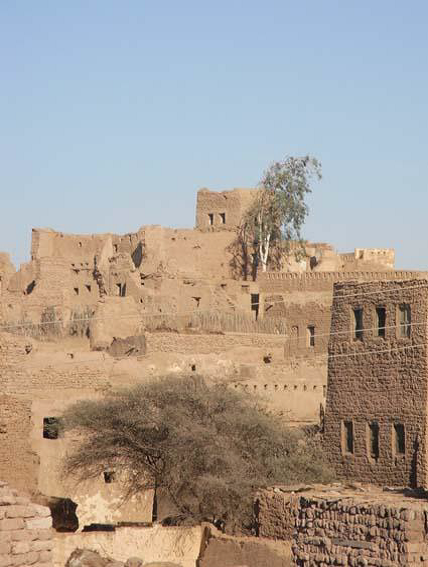
It was called Back of the Oasis in pharaonic times. It is known for the old part of the city, which is an
example of the traditional Islamic town built with sun-dried mud bricks:
twisting and narrow dark passages offer cool shade and protection from the desert
sun. The walls of the houses are without windows. The old Mut is still
inhabited. In the city of Mut there is also the Ethnographic Museum, which contains items used in Islamic times in
the oasis as well as figurines by the artist Mabrouk representing scenes from daily life.
There are not set opening hours for this museum; additional information can be
obtained at the Tourist Information Office. At southwest of Mut there is Mut el Khorab, Mut the Ruined, that is
an ancient site that was enclosed by a large temenos wall of mudbrick up to 8 m
thick in some places, probably constructed in the New Kingdom. Within this wall
there are remains of mudbrick structures from several ancient periods. In the
centre of the site are the remains of the sandstone temple dedicated to Seth,
probably built in the Late Period after the 25th dynasty. There is also a
church from the Late Roman/Byzantine period. The price (years 2019-2020) to
enter the ancient Islamic city is: 40 EGP (foreigner), 20 EGP (foreigner
student), 10 EGP (Egyptian), 5 EGP (Egyptian student). North to Mut there is
the Grave Mountain, a cemetery with
traditional mudbrick, domed tombs and unusual tombstones. Camel rides to the
Grave Mountain can be arranged by the Tourist Information Office or by some restaurants
(CISS Inventory 2010; Vivian 1990).